
WHO IS TRULY (KNOWINGLY) IN FAVOR OF DE-DOLLARIZATION?
By Mauro Marturano
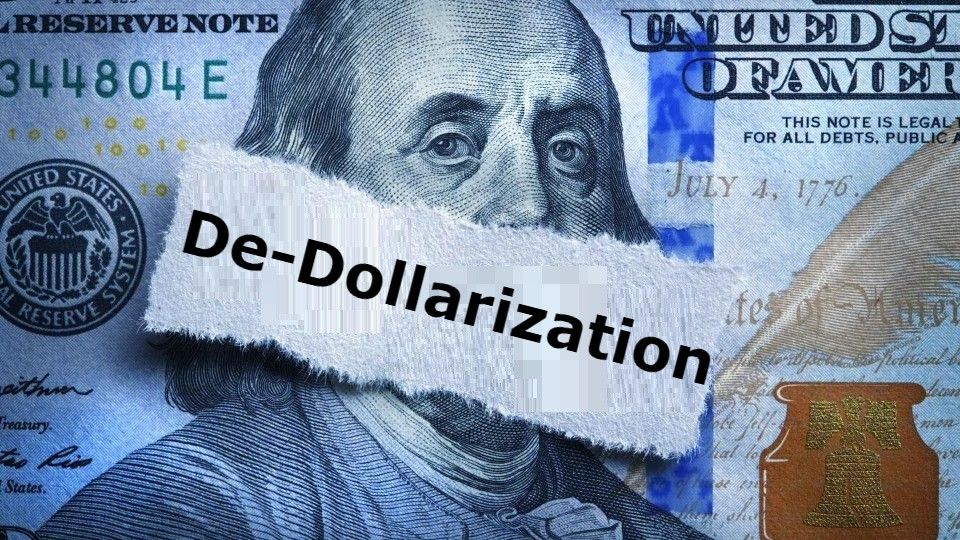
I have a vague feeling 😂.
But surely I'm the one who's wrong 😂.
99% of those who "cheer" for de-dollarization have not the slightest idea — and in saying this, besides being polite, I'm also being extraordinarily optimistic 😂 — of the key points of de-dollarization, that's all 😁.
And just imagine those who don't even "cheer" for it 😂, meaning those for whom... these, in fact, aren't problems, or "anyway there'll be someone (????😂) appointed (???😂) to solve them 😁."
Appointed 😂😂😂.
Good lord, what ignorance. Sweet baby Jesus 😂😂😂.
But, leaving the cursing aside, let me get to some education 😂 — not the national-team kind, there are already 56 million head coaches for that, since giving your two cents on whether Politano or Palestra should start doesn't take much effort 😂 — I mean financial education (of the highest caliber 😂).
Today I'll try to answer a question.
A question of biblical proportions: who benefits from de-dollarization?
First I'll give the answer, then I'll argue it.
De-dollarization benefits — or, better said, is necessary for — those who have printed dollars and all the derivative currencies (like the euro, like the pound, like the yen, like the dirham, and yes, even the yuan) and who have not only no will, but above all no real possibility, of exchanging our dollars/euros/yuan/yen/dirhams, etc. for real goods.
As long as money issuance was under control — that is, as long as there was a balance between goods purchasable with the issued currencies and actual real goods — there was no need whatsoever for de-dollarization.
People only started talking about de-dollarization once that spell was broken.
When someone talks about world debt — today at 348 trillion dollars 😂😂😂😂😂, 99.9% of you wouldn't even know how to write that number out 😂😂😂😂 — the real issue actually isn't distinguishing between debtors and creditors.
The real point is distinguishing between creditors who are going to get royally screwed 😂😂😂, who won't be able to convert their monetary claims — the currencies mentioned above, and the ones not mentioned 😂 — into real goods, and creditors who will actually make it.
The latter are a tiny fraction of the total 😁.
We could call them the miraculously saved 😂.
An Italian moron — moron not because he's Italian, you're basically morons the whole world over 😂😂😂, in the sense that you're all running a cognitive deficit 😂 — three years ago, when I explained the theory to him, the only true theory 😂, replied:
"There's no imbalance at all, because if goods ran short, prices would just adjust."
To this moron I replied:
"But if gasoline went to 50 euros a liter, meaning equilibrium got reached through prices, what do you think would happen?"
From the moron, obviously, no answer.
De-dollarization fits perfectly into this picture.
It's essential that something happen so that those who are going to get screwed understand nothing of what I've been explaining all along.
It's essential that there be "serious" justifications 😂 so that whoever gets screwed has, in their head, someone to blame 😂😂😂😂.
As I said at the start, I have the extraordinary feeling that people are cheering for something they not only don't understand, but whose implications they don't understand either.
For all these situations, I've always used one adjective, a single adjective: INEVITABLE.
What we're living through is inevitable because the system the financial system was built on — leverage and fractional reserve — could only lead to what we're experiencing now.
There were no other possibilities.
Breaking the dollarization paradigm means one thing — and one thing only — making the claims of those who worked / took on risk worth less, or worth nothing at all.
That's why I often talk about a change of unit of measurement.
Those who handed us dollars/etc., having nothing left to give us now in exchange for the paper they issued, will change the unit of measurement of our lives, rolling out some technological change, when the problem isn't technological at all and is, if anything, simply numerical.
It's the problem... of making the numbers add up.