
TOKENS IN THE WEIMAR REPUBLIC
By Mauro Marturano
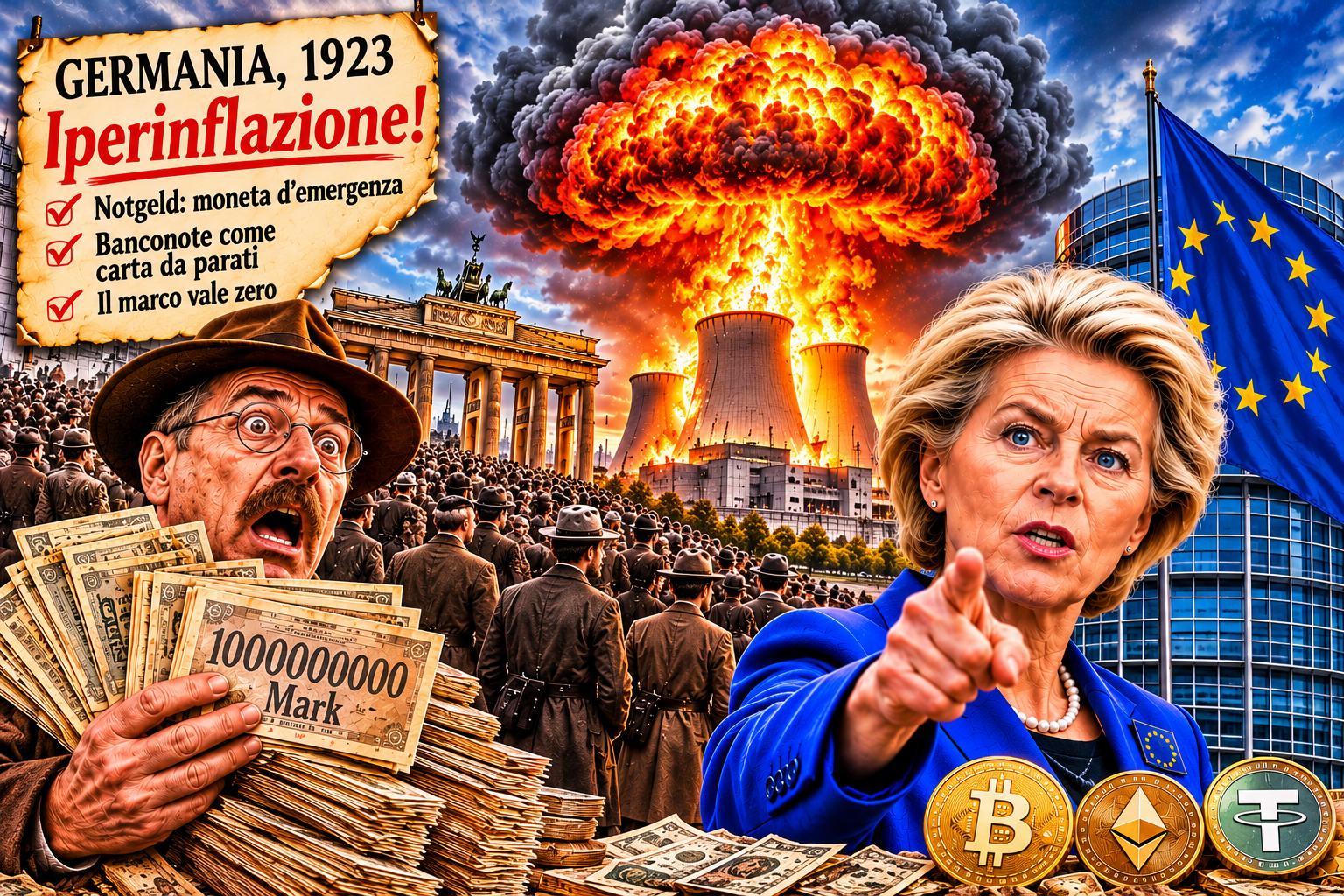
This morning I woke up... and, with Francesca not by my side, I couldn't think about life's succulent 😂 pleasures.
So 😂 I asked ChatGPT whether there had been any examples of tokens in modern history. Here's the answer.
During the Weimar Republic (1919–1933), particularly during the hyperinflation of 1921–1923, a very interesting phenomenon emerged: the creation of alternative currencies and means of payment outside the official currency system.
They were known as Notgeld, literally meaning “emergency money”.
What were Notgeld?
They were issued by municipalities, companies, banks and local authorities.
They could take the form of banknotes, coins or tokens.
They were intended to make up for shortages of official currency and facilitate trade.
Some could be exchanged for goods, while others were accepted locally on the basis of trust in the issuer.
In 1923, the German mark lost virtually all its purchasing power.
People needed enormous quantities of banknotes to buy everyday goods. In some cases, it was more practical to use banknotes as wallpaper than to keep them as savings!
The historical lesson is important: when confidence in the official currency collapses, people look for alternative instruments to store value and exchange goods.
In November 1923, the Rentenmark was introduced, helping to stabilize the situation.
The most extreme phase came to an end in November 1923, with the introduction of the Rentenmark. The Reichsbank stopped accepting Notgeld and ordered its withdrawal; some continued to circulate until the middle of 1924.
One interesting detail: at the worst point, thousands of municipalities, companies and institutions were issuing their own notes. There was therefore no single alternative currency, but a multitude of local issues.
In short, within just a few years, Germany experienced a genuine fragmentation of its monetary system.
Now I'm taking over again 😁 — actually, I AM taking over (because if Artificial Intelligence is written with capital letters, I don't see why I shouldn't be written in capital letters too) — to make a few observations and comparisons.
Let's start with the observations.
Ladies and gentlemen 😂😂😂... I hope you've realized that you're getting an Economics degree without paying a single cent 😂. Predictive Economics 😂, to be precise 😂.
And I hope you've also understood that “history may not repeat itself 100%, but it rhymes”.
Now for the comparisons:
- In the Weimar Republic, the peak of the hyperinflation crisis and, consequently, the peak in the use of tokens occurred in 1923.
I don't expect Europe to experience the kind of hyperinflation seen back then, because nowadays they've put a whole arsenal of tools in place to control it (Covid, Suez, wars, climate change, green policies, nuclear power plants, propaganda, etc.). And this vast array of tools has helped cushion the problem.
But it is precisely when the nuclear issue comes to a head that we will, one way or another, see a new inflationary peak and a serious banking crisis.
So we should expect a situation in which people will be talking about tokens and crypto at the local bar as “emergency currencies”.
As mentioned above, Notgeld were issued by practically everyone (municipalities, companies, banks, etc.). That's exactly what we're seeing today. Amazon has its own, Telegram has its own, JPMorgan has its own. Everyone is issuing worthless junk 😂.
According to what ChatGPT tells us, the acute phase ended when the Rentenmark was introduced in November 1923.
If that comparison holds, we could liken the Rentenmark to the Digital Euro.
Here too, as I told you before, the introduction of the Digital Euro (scheduled, supposedly, for 2029), the ultimate monetary prison (for us plebs 😂), the definitive solution to monetary imbalance, could mark the end of the crypto era.
An era which, if that comparison holds, will last no more than two years (2027 and 2028?), but it will be intense. Very intense indeed.
Over those two years, starting from the nuclear incident, the crypto world will wipe out the value of people's savings, especially those of Europeans.
Savings that Ms. Ursula has repeatedly told us (and ordered us 😂) are lying dormant.
Thank you, Ursula, for your financial advice!