
THE ORIGINS OF THE GREAT MONETARY FRAUD
By Mauro Marturano
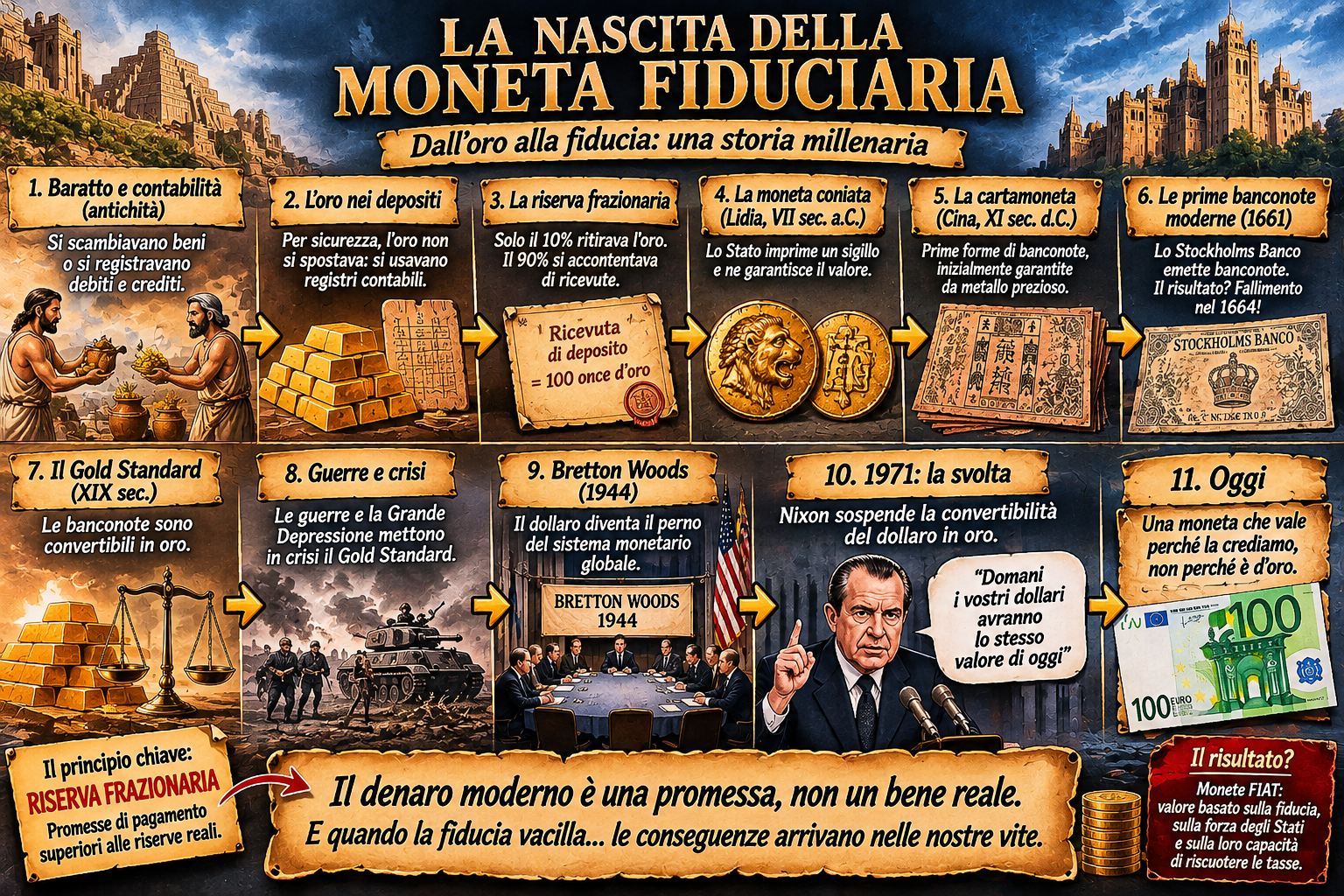
Before the introduction of money, people relied on barter (an extremely inconvenient method) or centralized accounting systems that recorded debts and credits, as was the case in Mesopotamia.
In the past, commercial transactions involved the exchange of physical goods, such as gold.
For practical and security reasons, however, gold did not necessarily have to be physically moved every time a transaction took place. During transportation, convoys were often attacked: by bandits on land and by pirates at sea, who were basically the hackers of their time 😂.
People therefore began using ledgers and accounting documents to certify the deposit, transfer, and ownership of a specific quantity of gold.
Essentially, the gold remained safely stored in vaults, while transactions took place through simple accounting entries.
At a certain point, those managing these deposits noticed something interesting: only a small percentage of depositors, around 10%, actually asked to withdraw their physical gold. The remaining 90% were perfectly happy with accounting records, using the documents to settle their transactions.
This observation created an entirely new opportunity: if almost nobody physically demanded their gold, it was possible to issue more certificates and receipts than the amount of gold actually held in reserve.
And so the principle of FRACTIONAL RESERVE BANKING was born (the very foundation of our present and our future, and something 99% of people have never even heard of — except from me and a few other "lunatics" 😂): the ability to put promises of payment into circulation in amounts greater than the reserves actually available.
Coined money, whose origins are traditionally traced back to Lydia around 600 BC, marked a historic turning point. For the first time, a public authority stamped a seal on a coin, certifying its weight and value. The state guaranteed its value by requiring taxes to be paid in that same currency, thereby creating demand for it and ensuring its circulation.
Citizens no longer had to weigh or assess the quality of every single coin, because they could trust the public authorities (the more things change, the more they stay the same 😂).
Moving forward in time, during China's Song dynasty, around the 11th century AD, the first forms of paper money began to develop. Initially, they were a kind of bank draft backed by silver and gold.
The first modern European banknote, on the other hand, was issued by the Stockholm Banco in 1661. It was very similar to modern banknotes: it had a fixed denomination, could be transferred without the need for endorsements, and was payable on demand to the bearer.
When the price of copper rose, many people requested the simultaneous redemption of their banknotes. By that point, the Banco had already issued certificates without adequate metallic backing, triggering a bank run that led to its collapse in 1664.
In Europe, TODAY, we don't face the same risk because 99% of people believe their money is safe in banks 😂.
Paper money spread throughout the world from that point onward because it was "portable": commercial transactions could take place more freely and easily using simple pieces of paper that had no intrinsic value.
And so modern "fiat" money was born, whose value derives directly from trust in the issuer (the Central Bank) and which has legal tender status, meaning it must be accepted as provided for by law.
In other words... they issue money without any underlying PHYSICAL ASSET and force their subjects to accept it.
Fiat money facilitates transactions, but it comes with a huge problem: since it has no intrinsic value, if the issuer loses credibility, those who hold it risk ending up with something that may lose a large part of its purchasing power.
The Gold Standard spread precisely because, following a series of crises and failures such as that of the Stockholm Banco, a form of guarantee seemed necessary: paper banknotes were convertible into gold held in bank vaults.
Essentially, central banks and governments could tell their citizens to place a little less trust in mere paper, because at any time it was possible to convert an "abstract value" (paper money) into a "real value" (physical gold).
The First World War and the Great Depression marked the collapse of the Gold Standard: to finance military spending and deal with economic crises, many countries suspended the convertibility of their currencies into gold.
With the Second World War behind them and the terrible 1929 crisis finally overcome, the time had come for Bretton Woods (1944), and the creation of the International Monetary Fund, whose specific task was to harmonize imbalances in international payments, prevent currency wars, and promote trade.
The Bretton Woods agreements officially marked the transition towards the dollarization of the international monetary system: the world was moving from a Gold Standard to a Dollar Standard.
In practice, only the US dollar was convertible into physical gold at a fixed rate, while all other currencies were pegged to the dollar, which officially became the world's main reference currency.
Bretton Woods didn't last long either: to finance the Vietnam War, the United States began putting more dollars into circulation than it had in gold reserves, resulting in a sharp increase in requests to convert dollars into physical gold.
On August 15, 1971, Nixon announced on live television the suspension of the dollar's convertibility into gold and delivered a sentence that would become iconic: "Tomorrow, your dollars will be worth exactly the same as they are today."
From that moment on, all major national currencies became "FIAT" currencies, whose value is no longer guaranteed by an underlying physical asset, but by the credibility and trust placed in the issuer.
In other words, by a state's future ability to collect taxes and, above all, by its ability to go and steal resources from other parts of the world.
I'll conclude by saying that "we are exactly where we were always destined to end up." If you understand the implications of this text, you can only agree. It has been 55 years since 1971 — 55 years of fraudulent money creation!!
The consequences of creating money in a completely reckless, slapdash manner were bound to catch up with us eventually.
P.S. I studied Management and Financial Engineering at the Polytechnic University of Milan, took at least 15 Economics and Finance exams, and despite all that, I don't remember ever having had an in-depth discussion of the issues covered in this text — or of the topics I've been talking about for at least 10 years.